
Most greenhouse investments in the Middle East start from the same idea. More control. More technology. Less risk.
And yet, in practice, I often see the opposite happen.
The more we try to fully control the climate, the more dependent the system becomes. And the more fragile the return.
After living and working in the Middle East for eight years, I started to look at agriculture differently. What stayed with me were not the big political conversations, but the personal ones. Stories about fathers and grandfathers who produced their own food with limited resources. Stories about pride, independence and responsibility. Food production was never just business. It was something of your own.
In recent years, something has been shifting. Quietly, but clearly. Supply chains are becoming more complex, prices more volatile, and reliance on imports less obvious. And without always saying it out loud, many investors are asking the same question: How do we regain more control, without compromising on quality and return? For me, part of that answer lies in locally grown soft fruit. Strawberries, blueberries, raspberries and blackberries are not commodity crops. Their value is defined by freshness, taste and quality. And that makes them ideal for local production.
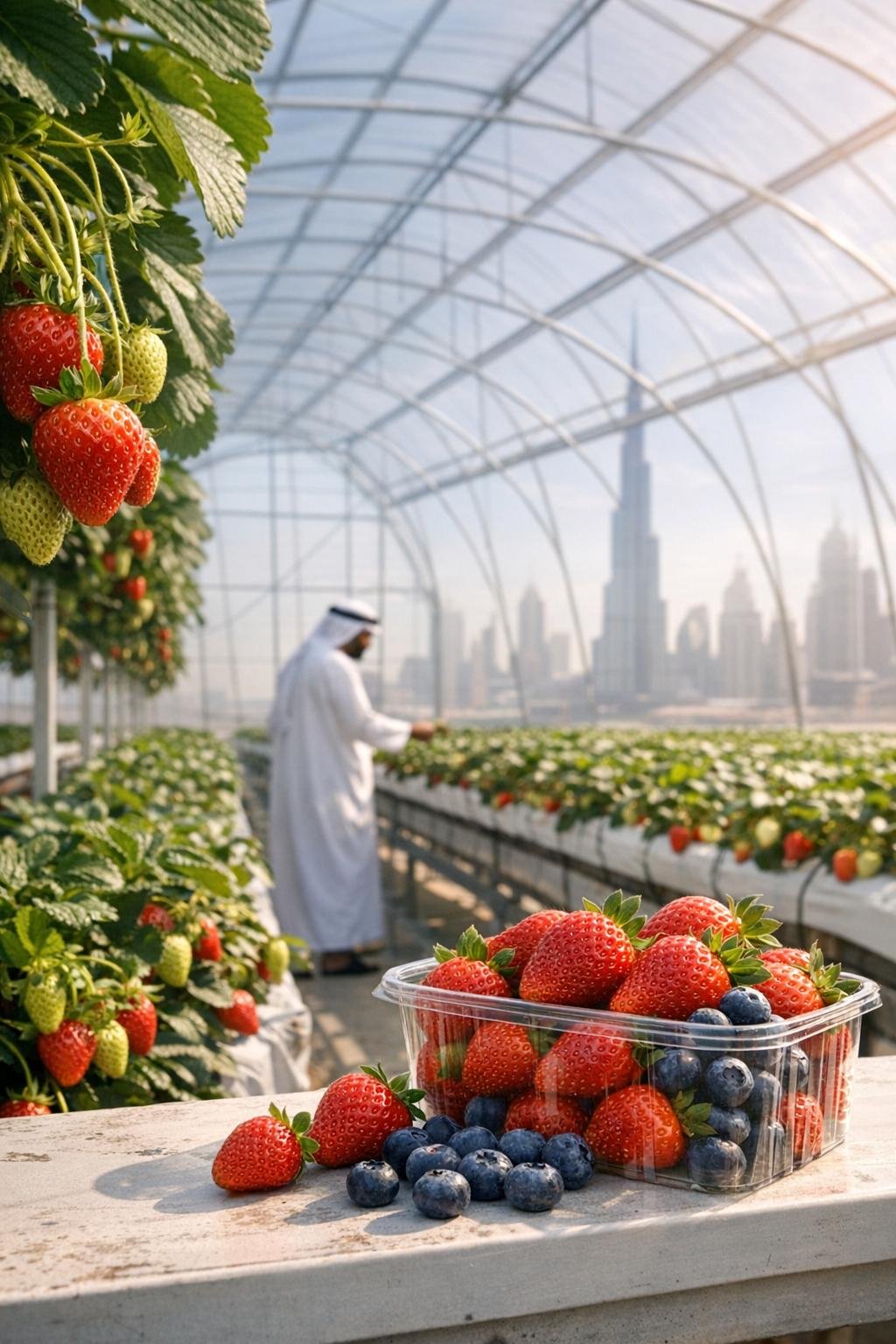
The value of softfruit is defined by freshness, taste and quality. And that makes them ideal for local production.
But this is where the tension begins.
Many projects rely on fully closed, high-tech greenhouses. Understandable. They offer a sense of control. But control is not the same as security. In hot climates, these systems often depend heavily on energy, cooling and technical precision. When everything works, they perform well. But when conditions shift, costs rise quickly and margins come under pressure.
Especially with soft fruit. That made me rethink the approach.
Not how to add more technology, but where we can remove it and let nature do part of the work, without losing control. This led to a different type of greenhouse. A structure with a fully open and closing roof, within one minute. At the right moments, you grow with natural sunlight and ventilation. When conditions become extreme, you close and take control again.
Combined with a double horizontal screen, a diffuse screen for light distribution and an energy screen for temperature control, and a well-designed fog system, it creates a stable environment for soft fruit production. For fruit growers in warmer regions this balance is essential. Excess heat and humidity can reduce fruit firmness, increase disease pressure and affect shelf life.
But the greenhouse itself is only part of the story.
We work closely with highly experienced crop consultants who fine-tune every project together with the investor and grower. Water quality, nutrition strategy, crop selection, everything is integrated. And we don’t just focus on capex. We work together on realistic opex as well. Because that is where the real difference is made.
What is often perceived as “safe” turns out to be highly dependent on energy and technical input. A system that works with the climate may require a different mindset, but it often brings more operational stability.
Less dependency. Less correction. More balance.
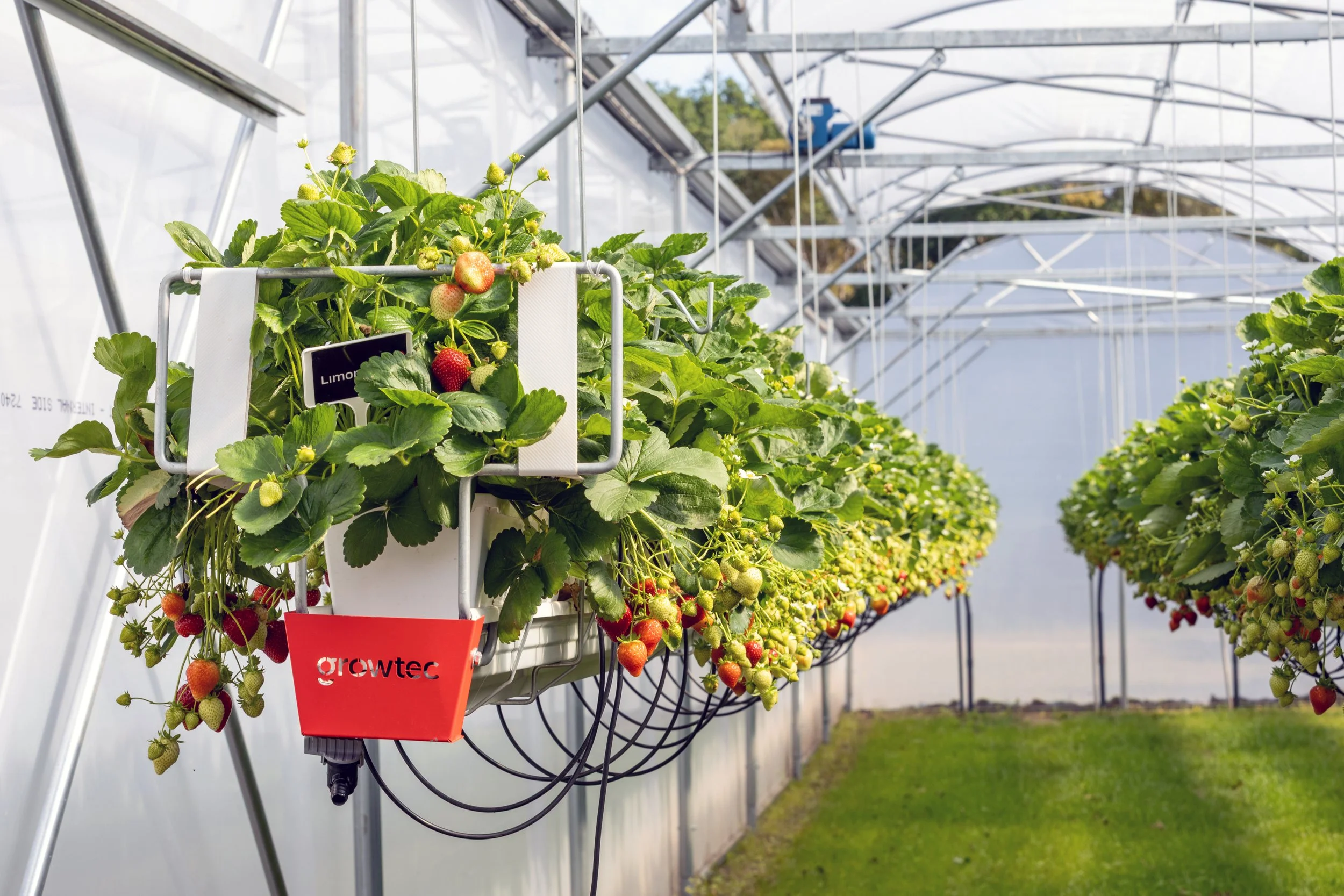
Example of a hanging hydroponic system for strawberries
What I see in practice:
Projects producing 7–8 months with lower operational costs and higher fruit quality often outperforming systems running 12 months. Not because they do less, but because they are designed smarter.
And maybe that is the real point. I have never known Middle Eastern investors to choose the easy or safe path.
They are builders.
They take calculated risks.
They move forward where others hesitate.
I have never known Middle Eastern investors to choose the easy or safe path.
So the question is not whether there is risk. The question is which type of risk you choose. Do you invest in maximum control and maximum dependency. Or in a system that works with the climate and becomes more resilient?
I know where I stand.
And I see more and more investors in Saudi Arabia, the UAE, Jordan and Iraq exploring that same direction.
If this resonates with you, let’s talk. Not to sell something, but to explore what works in your specific situation. Because the future of soft fruit in this region is not about more control
It is, in my opinion, about the right balance.
Jacco van Delden, Managing Director Rovero Systems BV